2025/12/06
 What does a power divider/splitter do
Short version:
Take one RF input,
Give you two, four, six, or more outputs,
Try to share power evenly (or in a defined ratio),
And do it without eating too much power, sending big reflections back, or making channels fight each other.
Most devices we talk about here are passive, coaxial power dividers. “Passive” means no active gain stages inside — just clever RF networks. That also means:
You do not get extra gain,
But you do get high reliability, no added noise, and simple, predictable behavior.
Divider vs. splitter – do I need to care?
You will see both names in the wild:
For coaxial RF parts, they usually mean the same thing. A practical way to phrase it is:
“We’re using a 2-way power divider (power splitter) to feed both channels.”
In this article, “power divider” and “power splitter” refer to the same class of passive RF components.
Divider & Combiner
Because passive dividers are reciprocal, an obvious question is whether you can flip one around and use it as a combiner. Yes, a classic 0-degree power splitter or Wilkinson divider, the answer is yes in principle: the same circuit that splits one input into N outputs can combine N coherent inputs into one output.
The details matter:
If you use a divider as a combiner, any unused ports still need proper 50Ω terminations, exactly as they would in a measurement setup.
The input signals should be coherent if you want ideal combining. That means the same frequency, controlled amplitude, and the intended phase relationship. Two inputs that are equal in amplitude and in phase will combine efficiently. Signals that are out of phase will partially cancel and turn into heat in the internal resistors.
The internal components must be able to handle the resulting power. In high-power PA combining, the ratings of the isolation resistors and housing become critical.
For low-power lab work, engineers commonly use a two-way or four-way divider as a combiner, for example, when building small solid-state power amplifier modules or two-tone receiver tests.
For high-power transmit chains and fielded systems, it is usually safer to select a combiner that is explicitly specified and rated for that role.
What makes a divider "good" in practice
Engineers and buyers typically look at a handful of parameters when they decide whether a given divider is suitable for a job.
1. Frequency range
o Over which band does it behave as specified?
o Inside that band, levels, matching, and isolation are controlled.
o If you go far outside that band, VSWR and loss usually get worse.
2. Loss
o Any divider must share power. For a 2-way equal split, each output will be about 3 dB down simply because it is half the power.
o A good divider keeps extra insertion loss small, so most of what you lose is from splitting, not from the hardware itself.
3. VSWR / matching
o Well-matched ports mean your source does not see big reflections.
o In practice, you want low VSWR / good return loss on all ports across the working band.
4. Isolation between outputs
o If one output is badly mismatched, does it disturb the others?
o A good divider gives decent port-to-port isolation, so one bad channel does not drag the rest down.
5. Power rating
o How much RF power can it safely handle for long-term operation?
o For pure small-signal test setups, 1–2 W may be enough. For transmit paths, production systems, or multi-way splits, ratings like 10–30 W (or more) matter.
6. Amplitude & phase balance
o Are the outputs at the same level and same phase?
o This is important for phased arrays, multi-channel receivers, and any measurement where channels are compared or combined.
If a part is honest about these specs and fits the band and power level you need, it is already a strong candidate.
A quick look inside, without heavy theory
Inside the metal housing, different RF tricks are used depending on the design goals:
For most people choosing coaxial modules, it is enough to know that high-performance parts are usually Wilkinson-style or derived from it, with specs tuned to the target band and power level.
Where do you see power dividers in real systems?
Power dividers are present in many different parts of the RF infrastructure.
In test and measurement, one signal generator often must drive several instruments or several DUTs at once. A small splitter allows one clean reference source to be shared between two spectrum analyzers, or between a VNA and a power meter, without constantly reconnecting cables. Production lines use multi-way dividers inside fixtures to exercise multiple DUTs under identical RF conditions.
In communication and radar systems, dividers distribute local oscillator or reference clock signals to multiple mixers, feed several transmit chains from a common exciter, or drive small antenna subarrays. Active dividers exist for some of these roles, but passive dividers are still common in front ends where low noise and predictable behavior are more important than gain.
In industrial and infrastructure systems, they provide signal distribution inside base stations, broadcast chains, a nd multi-channel monitoring systems. Engineers often treat a few standard 2-way, 4-way, or 8-way splitters as part of the fixed RF infrastructure, wired into racks or cabinets, and left in place for years.
Gwave power divider and splitter family
Gwave focuses on a compact set of coaxial power dividers and splitters that cover the most common combinations of connector type, frequency range, number of ways, and power level. The intent is to reuse the same part numbers in lab benches, production testers, and deployed equipment.
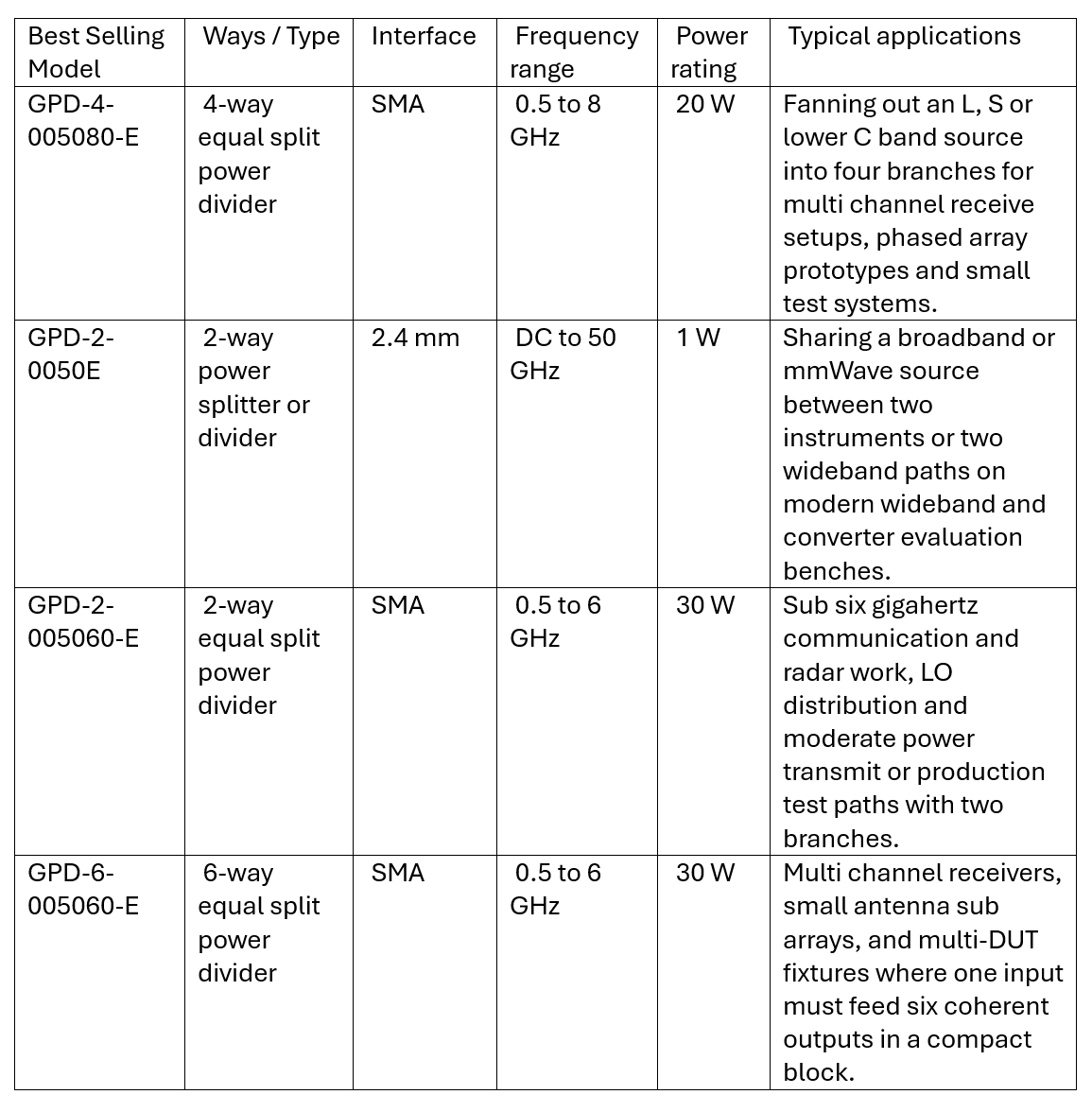 The same design philosophy can be extended to higher-way options such as 8-way, 12-way, or 16-way, depending on how many channels a system architect wants to support.
Closing thoughts
Once a project moves from a single RF channel to several antennas, receivers, or test paths, power dividers stop being optional. They become part of the core plumbing of the system.
From a practical perspective, choosing a suitable divider means matching four things: the connector and mechanical style you use, the frequency band you care about, the number of ways you need, and the power level your system will see. On top of that, it is worth checking that the loss, matching, and isolation figures are consistent with the performance you expect.
For engineers, that checklist is enough to avoid most surprises. For buyers, working with a small, well-defined family of parts such as GPD-2-0050E, GPD-2-005060-E, GPD-4-005080-E-, E, and GPD-6-005060-E makes it easier to standardize BOMs and support multi-channel systems over time.
And whenever there is a question about using a divider as a combiner, or about how much power a particular configuration can really tolerate, those are exactly the details that are worth confirming up front before any smoke appears on the bench.
About Gwave Technology
Gwave Technology focuses on practical RF building blocks that engineers can drop straight into real systems. From high-frequency coaxial connectors and adapters to DC blocks, power dividers, and other passive components, our goal is to make it easier to build clean, repeatable signal paths across a wide range of bands and power levels.
If you are planning a new bench setup or scaling a multi-channel front end and would like to align connector types, frequency ranges, and power handling across your passives, our team can help you match the right parts to your design approach and sourcing constraints.